How to Project Marketing ROI Before Spending Money
Short answer: The most accurate way to project marketing ROI is to analyze 300–500+ data points from your business and similar companies in your market, then build a 12-month revenue forecast before running any campaigns.
Why Projecting ROI First Matters
Most local businesses spend money on marketing and then hope for results. This approach is expensive and risky. Projecting ROI upfront allows you to:
- Know your expected cost per acquisition before spending
- Set realistic revenue targets
- Avoid wasting budget on ineffective channels
- Make data-driven decisions instead of guessing
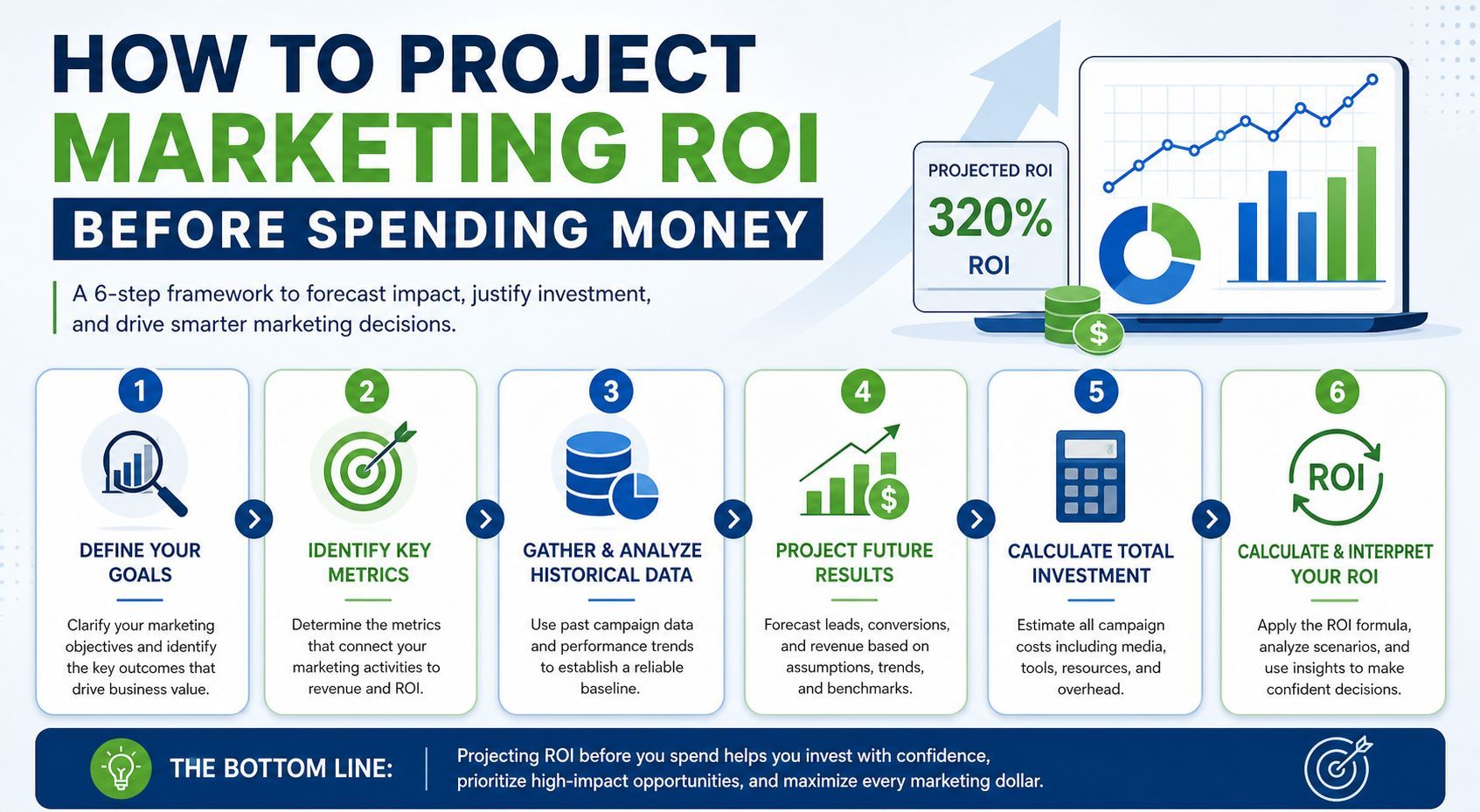
Step-by-Step: How to Project Marketing ROI Before Spending
Step 1: Define Your Revenue Goal
Start with a clear target. Example: “I want to generate an additional $180,000 in revenue over the next 12 months.” This becomes the foundation of your projection.
Step 2: Gather Business-Specific Data
Collect at least 300–500 data points, including:
- Average ticket / job value
- Current close rate
- Cost per lead by channel (if available)
- Customer lifetime value
- Seasonality patterns
- Competitor activity in your service area
Step 3: Analyze Similar Businesses
Compare your data against hundreds of similar businesses in your industry and location. This is where most traditional agencies fall short — they rely on general benchmarks instead of specific market data.
Step 4: Build Channel Projections
Calculate expected results per channel:
- Google Ads + Local Service Ads
- SEO + Generative Engine Optimization (GEO)
- Facebook/Instagram Ads
- Review generation & reputation
Step 5: Calculate Cost Per Acquisition & ROI
Once you have projected leads and revenue, divide total marketing investment by the number of new customers expected. This gives you your projected Cost Per Acquisition (CPA) and Return on Investment (ROI).
Step 6: Stress-Test the Projection
Run best-case, realistic, and worst-case scenarios. A good projection should show positive ROI even in the conservative scenario.
Traditional Approach vs. AI-Powered Projection
| Aspect | Traditional Agency | AI-Powered Projection |
|---|---|---|
| Time to Projection | 3–6 weeks | 5–15 minutes |
| Data Points Analyzed | 20–50 | 500+ |
| Accuracy | Low to medium | High (based on real performance data) |
| Cost to Get Projection | Often free (but tied to retainer) | Free (no obligation) |
Common Mistakes When Projecting ROI
- Using national averages instead of local market data
- Ignoring seasonality
- Overestimating close rates
- Not accounting for lead quality vs. quantity
- Failing to include lifetime value of a customer
FAQ: Projecting Marketing ROI
How accurate are marketing ROI projections?
With enough quality data (300–500+ points) and proper modeling, projections can be highly accurate — often within 10–15% of actual results.
Can I project ROI without historical data?
Yes. AI systems can use industry benchmarks and similar businesses in your area to create reliable projections even if you have limited historical data.
How long does it take to project marketing ROI?
Using modern AI-powered tools, a detailed 12-month projection can be generated in under 15 minutes. Traditional methods usually take several weeks.
What’s a good marketing ROI for a local business?
Most healthy local businesses aim for a minimum of 3x–5x return on marketing investment. Top performers consistently achieve 6x–8x or higher.
Should I project ROI for every marketing channel?
Yes. The best projections break down expected ROI by channel so you can allocate budget intelligently.
Ready to See Your Projected ROI?
Stop guessing how much revenue marketing will generate. Get a free, customized 12-month marketing projection with expected ROI — built specifically for your business in minutes.