How Much Should a Local Business Spend on Marketing in 2026?
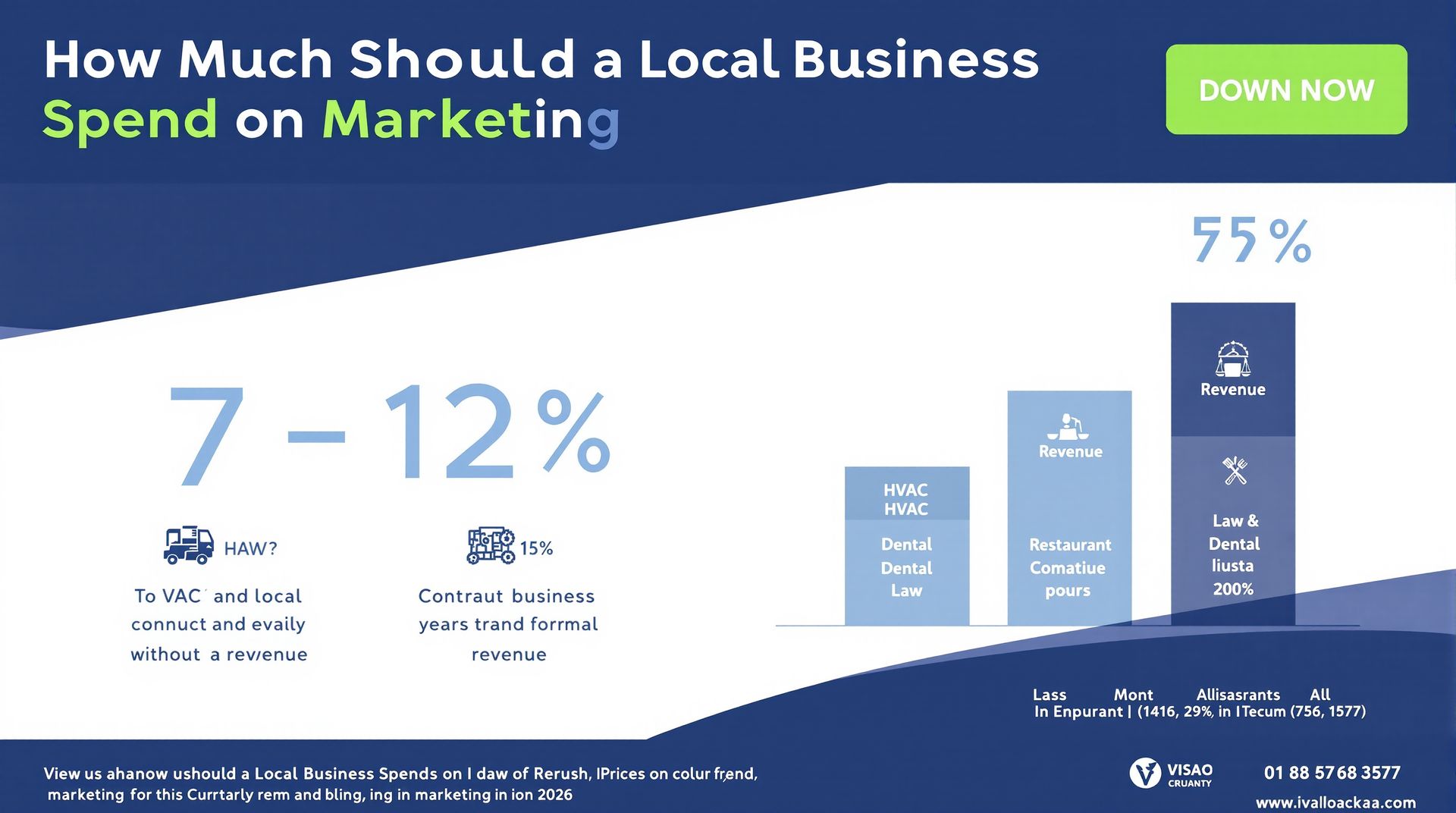
Short answer: Most successful local businesses should invest between 7% and 12% of their annual revenue on marketing in 2026. High-growth businesses often spend 10–15% when launching new services or entering new markets.
Marketing Budget Benchmarks for Local Businesses (2026)
| Business Type | Recommended % of Revenue | Typical Monthly Spend ($500K Revenue) | Notes |
|---|---|---|---|
| Home Services(HVAC, Plumbing, Roofing, Electrical) | 8–12% | $3,300 – $5,000 | High competition in “near me” searches |
| Healthcare(Dental, Medical, Med Spas) | 7–10% | $2,900 – $4,200 | Strong ROI from Google Local Service Ads |
| Professional Services(Law, Accounting, Consulting) | 6–9% | $2,500 – $3,750 | Focus on content + GEO |
| Restaurants & Retail | 8–15% | $3,300 – $6,250 | Higher spend on social + local ads |
| High-Growth Businesses | 10–15% | $4,200 – $6,250 | Expanding service areas or adding locations |
Key Factors That Should Influence Your 2026 Marketing Budget
1. Your Growth Goals
If you want to grow revenue by 30%+, plan to spend closer to 10–12%. If you’re happy maintaining current revenue, 6–8% is often sufficient.
2. Competitive Landscape
In highly competitive categories (HVAC, roofing, dental), businesses spending below 8% of revenue usually lose market share to more aggressive competitors.
3. Use of AI & Automation
Businesses using AI-powered marketing systems can often achieve the same results with 20–30% less spend compared to traditional agencies because of better targeting and automation.
4. Channel Mix
- Paid Search + LSA: Fastest ROI (typically 3–6x return)
- SEO + GEO: Higher long-term return but slower ramp-up
- Social + Review Generation: Strong for reputation and local visibility
Recommended Budget Allocation for Local Businesses in 2026
Here’s a proven allocation that works well for most local businesses:
- 35% — Google Ads + Local Service Ads
- 25% — SEO + Generative Engine Optimization (GEO)
- 15% — Facebook/Instagram Ads
- 10% — Website & Conversion Optimization
- 10% — Review Generation + Reputation Management
- 5% — Chat/Voice Bots & Automation
Common Mistakes Local Businesses Make With Marketing Budgets
- Spending too little (under 6%) and expecting big results
- Spreading budget across too many channels
- Not tracking cost per acquisition properly
- Using fixed retainers instead of performance-based pricing
- Ignoring Generative Engine Optimization (appearing in ChatGPT, Gemini, Perplexity)
FAQ: Local Business Marketing Budgets in 2026
How much should a small local business spend on marketing?
Most small local businesses doing $300K–$800K in annual revenue should budget between 8% and 12% of revenue on marketing.
Is 5% of revenue enough for marketing?
Generally no. Businesses spending under 6–7% usually struggle to grow or maintain market share in competitive local markets.
Should I spend more on Google Ads or SEO in 2026?
Use a mix. Most successful local businesses allocate roughly 60% to paid channels (for immediate results) and 40% to SEO + GEO (for sustainable growth).
Can AI marketing reduce my marketing costs?
Yes. AI-driven systems often deliver the same or better results at 20–30% lower cost because of improved targeting, automation, and precise budget allocation.
How do I know if my marketing spend is working?
Track cost per acquisition (CPA), return on ad spend (ROAS), and new customer lifetime value. A healthy local business should see at least 3–5x return on marketing investment.
Ready to Build a Data-Driven Marketing Plan for 2026?
Stop guessing how much to spend. Get a free, customized 12-month marketing plan with projected revenue and recommended budget — built specifically for your business.